
High Cortisol Symptoms in Women: The Signs of Elevated Cortisol
Quick answer: High cortisol symptoms in women most often include weight gain around the midsection (“cortisol belly”), a rounder or puffier face, fatigue that is worst in the morning, waking around 2am, low stress tolerance, and salt or sugar cravings. Cortisol is the body's main stress hormone, and when it stays elevated it changes where you store fat, how you sleep, and how you feel day to day.
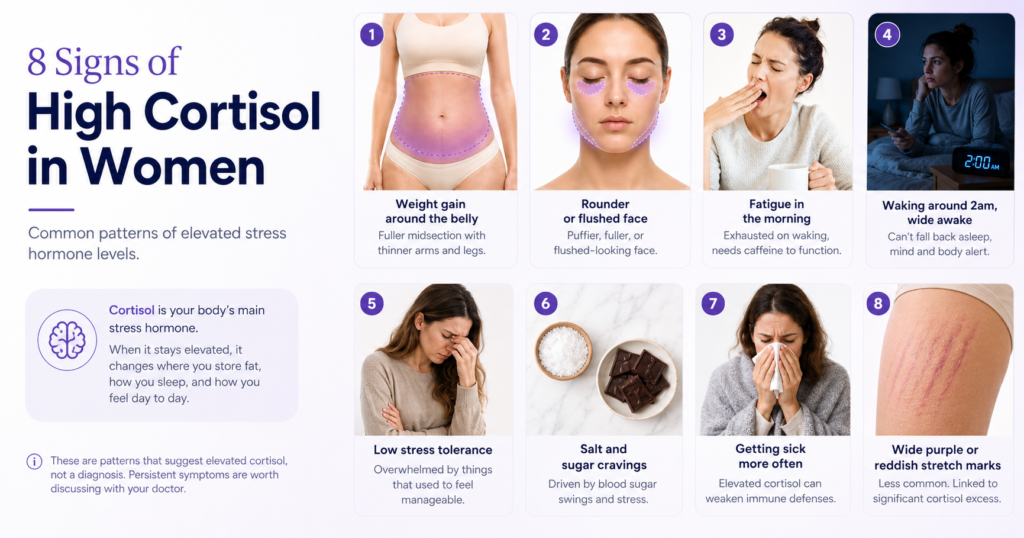
Signs of high cortisol in women, at a glance:
- Weight gain concentrated in the belly, with thinner arms and legs
- A rounder, fuller, or flushed-looking face
- Fatigue in the morning, a second wind late at night
- Waking around 2am, wide awake
- Feeling overwhelmed by things that used to feel manageable
- Salt and sugar cravings
- Getting sick more often
- Wide purple or reddish stretch marks (less common)
These are patterns that suggest elevated cortisol, not a diagnosis. Persistent symptoms are worth discussing with your doctor.
Cortisol is your body's primary stress hormone. In the right rhythm it wakes you up in the morning, helps you respond to challenges, and winds down at night. The problem is when it stays high, from chronic stress, poor sleep, ongoing inflammation, or blood sugar swings, because elevated cortisol quietly changes your body in ways that are easy to dismiss as “just stress” or “just getting older.”
In women specifically, high cortisol tends to show up in a recognizable pattern across weight, sleep, mood, and even the face. Here are the signs, why they happen, and how they connect.
1. Weight gain around the belly (“cortisol belly”)
One of the most talked-about signs is weight that settles around the midsection while the arms and legs stay relatively lean. There is a real mechanism behind this. Visceral fat, the fat around your organs in the abdomen, carries a higher density of cortisol receptors than fat elsewhere in the body. So when cortisol runs high, the body preferentially directs fat toward the midsection.
Cortisol also breaks down muscle and fat in the limbs. That combination, fat added to the belly and tissue pulled from the arms and legs, is why the classic high-cortisol pattern is a fuller midsection with thinner limbs. It is a pattern you can often see, not just measure.
2. A rounder or flushed face (“cortisol face”)
“Cortisol face” has become a popular term for a rounder, puffier, or flushed-looking face associated with elevated stress hormones. In its extreme form, a very round “moon face” and facial flushing are hallmark signs of Cushing's syndrome, a condition of pathologically high cortisol. Most women noticing mild facial fullness do not have Cushing's, which is rare.
What is far more common is chronic, low-grade cortisol elevation from everyday stress, poor sleep, and inflammation, which can contribute to facial puffiness and fluid retention. It is a softer version of the same underlying pattern.
3. Fatigue that is worst in the morning
Healthy cortisol peaks shortly after you wake and tapers through the day. When the rhythm is disrupted, mornings often feel the hardest, exhausted on waking, reliant on coffee to feel remotely normal, then a couple more cups just to get through. Feeling most tired at the time you should feel most alert is one of the more telling signs the cortisol rhythm is off.
4. A second wind at night, then waking at 2am
The other side of a disrupted rhythm shows up at night. Many women describe a second wind around 10 or 11pm, wired and unable to fall asleep even while exhausted. Then, having finally fallen asleep, they wake around 2am, suddenly wide awake, sometimes with a tight chest or mild reflux, before drifting back a couple of hours later and waking depleted again.
This “wired but tired” pattern, tired all day, alert at night, is one of the most recognizable signatures of early high cortisol.
5. Low stress tolerance and feeling overwhelmed
When cortisol has been elevated for a while, resilience drops. Things that used to feel manageable start to feel overwhelming. Small stressors land harder than they should. This is not a character flaw or simply “being busy”, it is a physiological sign that the stress system is running hot and has less headroom.
6. Salt and sugar cravings
Cravings for salt and for sugar are both linked to a dysregulated stress response. Cortisol influences blood sugar (it raises glucose), and the resulting swings can drive cravings for quick energy. Salt cravings tie into how the adrenal stress system regulates minerals and fluid balance.
7. Getting sick more often
Chronically elevated cortisol suppresses parts of the immune system. If you find you are catching every cold that goes around, or taking longer to recover, ongoing high cortisol may be part of the picture.
8. Wide purple or reddish stretch marks (less common)
Wide stretch marks (greater than about 1 cm) with a purple or reddish color are a more specific sign. Cortisol breaks down collagen, thinning the skin, so it tears more easily when stretched. These marks are strongly associated with significant cortisol excess and are worth raising with a doctor, though most everyday high-cortisol patterns do not produce them.
Why high cortisol affects so much at once
The reason high cortisol symptoms in women feel scattered, weight, sleep, mood, cravings, immunity, is that cortisol touches nearly every system. It raises blood sugar. It suppresses the signaling that drives sex hormone production, which can disrupt ovulation and cycles. It affects thyroid function and the immune system. So symptoms people write off as “just stress” are often the visible edge of a much wider hormonal ripple.
This is also why a single blood or saliva reading can be misleading. Cortisol follows a daily curve, and the problem is often the rhythm, high when it should be low, low when it should be high, rather than a single number being out of range. The more useful question is what pattern your symptoms form together, and whether cortisol is the system driving them.
What to do if you recognize these signs
If several of these signs sound familiar, the goal is not to panic about one symptom but to look at the pattern and address the inputs: sleep quality and timing, chronic stressors, blood sugar stability, and nutrient status. These foundations do more for cortisol rhythm than any single quick fix. Persistent or severe symptoms, especially wide purple stretch marks or pronounced facial changes, are worth discussing with your doctor to rule out underlying conditions.
Frequently asked questions
What are the first signs of high cortisol in women?
Early signs often show up as disrupted energy and sleep before anything else: fatigue in the morning, a wired second wind at night, and waking around 2am. Weight settling around the midsection, low stress tolerance, and salt or sugar cravings are also common early patterns.
What is a “cortisol belly”?
“Cortisol belly” refers to weight gain concentrated around the midsection driven by elevated cortisol. Visceral fat around the organs has more cortisol receptors than fat elsewhere, so high cortisol tends to direct fat toward the belly while breaking down tissue in the arms and legs, producing a fuller midsection with thinner limbs.
Is “cortisol face” real?
A rounder, puffier, or flushed face can be associated with elevated cortisol and fluid retention. The dramatic “moon face” version is a sign of Cushing's syndrome, which is rare. Milder facial fullness is more often linked to everyday chronic stress, poor sleep, and inflammation.
Can you have high cortisol with normal blood tests?
Yes. Cortisol follows a daily rhythm, and the issue is often the timing of that rhythm rather than a single value being out of range. A one-time reading can look normal while the daily pattern is disrupted, which is why symptoms across sleep, energy, weight, and mood are often more informative than a single test.
When should I see a doctor about high cortisol symptoms?
See a doctor if symptoms are persistent or severe, particularly wide purple stretch marks, a pronounced round face, or significant unexplained changes in weight or blood pressure. These warrant medical evaluation to rule out underlying conditions. This article is educational and not a diagnosis.
See whether cortisol is your primary pattern
High cortisol rarely acts alone, it ripples into thyroid, blood sugar, and sex hormones. The free Hormora hormone quiz walks you through the patterns across all six systems and shows you where your primary imbalance likely sits.
Hormora does not diagnose, treat, cure, or prevent any medical condition. This article is educational and is not a substitute for professional medical care. Individual results vary. Talk to your doctor before making changes to medication.